

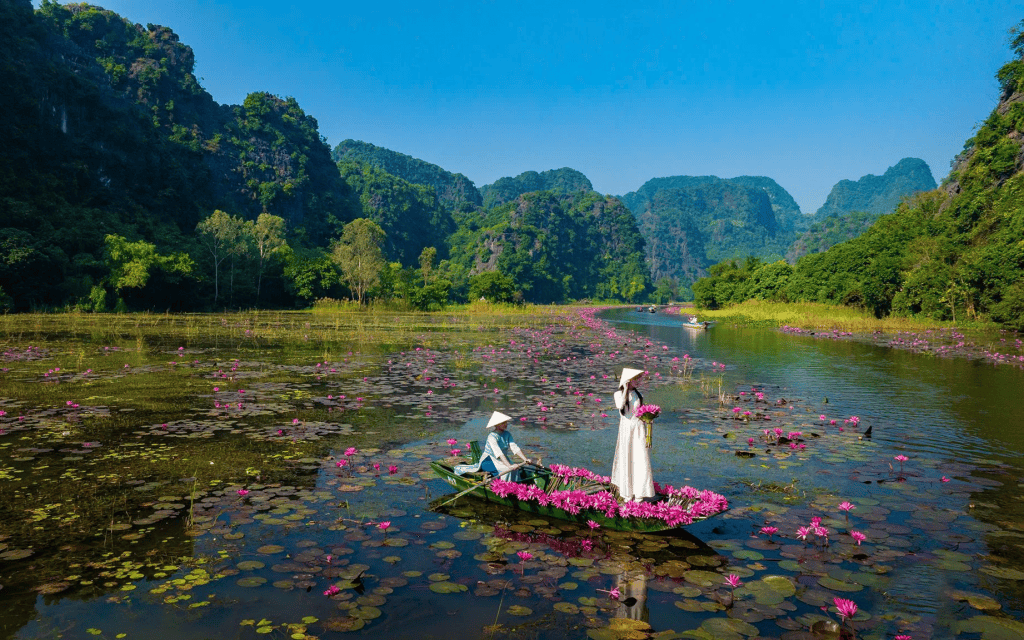
Two hours south of Hanoi, the road narrows, the rice paddies flood silver, and the karsts appear – limestone towers rising out of the water like something a painter invented. Cinematic enough that Kong: Skull Island was filmed here, significant enough to hold UNESCO World Heritage status since 2014. But what makes Ninh Binh worth a trip isn’t the scenery alone – it’s how quiet it still is. Swap the tour boats for a private sampan, and the loudest sound becomes an oar dipping into water.
1. Why Ninh Binh Belongs on the Luxury Map
1.1 A UNESCO Landscape Built for Exclusivity, Not Crowds
There’s a reason Ninh Binh keeps showing up on “next Ha Long Bay” lists – same karst drama, none of the tour-boat flotillas. Layer in 30,000 years of human history beneath the limestone, and it feels like a discovery, not a tourist stop.
- A dual heritage listing: Trang An was inscribed as a mixed cultural and natural UNESCO site in 2014, citing over 30,000 years of human occupation beneath the karst – see the official listing.
- Wilderness close to the road: limestone towers, flooded caves, and hidden lagoons feel like genuine wilderness, yet sit a short transfer from town, per Vietnam Tourism’s guide.
- A route worth trusting: worth building a full day around, not rushing through – gliding by traditional boat past karsts, temples, and hidden caves at your own pace.
- A pause within the north-south arc: Ninh Binh threads naturally into trips linking Hanoi, Ha Long or Lan Ha Bay, Hue, and Hoi An – a chapter a good tailor-made journey is built around.
A UNESCO-grade landscape with none of the overtourism baggage now shadowing Ha Long Bay.
1.2 The “Non-Stop Sensory Roller Coaster,” Slowed Down
Vietnam throws everything at you at once – Hanoi’s horns, mountain switchbacks, Ho Chi Minh City after dark. Exhilarating, eventually exhausting. Ninh Binh is the exhale.
- Intensity, distilled into stillness: the country moves like a non-stop sensory roller coaster from mountain peaks to hectic streets – Ninh Binh is where that ride pauses.
- A genuine slow-travel moment: recent coverage names Vietnam a leader in Asia’s slow-tourism shift, Ninh Binh cited alongside Hoi An and Hue – see Travel and Tour World’s coverage.
- A luxury pipeline that backs it up: Vietnam’s 2026 hotel outlook forecasts a strategic shift toward luxury nationwide – detailed in Vietnam’s Hotel Playbook 2026.
- Suited to your own pace: Ninh Binh rewards lingering over a sunrise cruise rather than clock-watching on a coach tour – what FIT and independent travel protects.
Vietnam’s intensity gives way to stillness here – and stillness is the new luxury currency.
2. Private Water, Not Shared Boats
2.1 Sampan Cruises Without the Flotilla
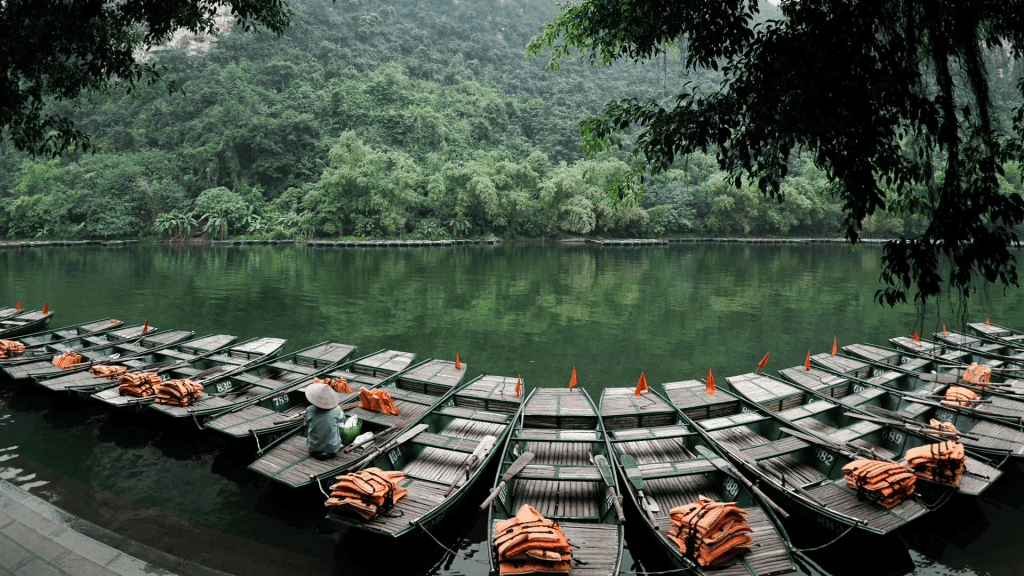
Picture the version of Tam Coc most photos never show: no queue, no flotilla, just you, a wooden sampan, and water no other oar has touched yet. That version exists – you just have to book it differently.
- What private access buys you: standard Tam Coc rowing-boat queues stretch for hours in peak season; a chartered sampan removes the wait and lets you choose sunrise light instead.
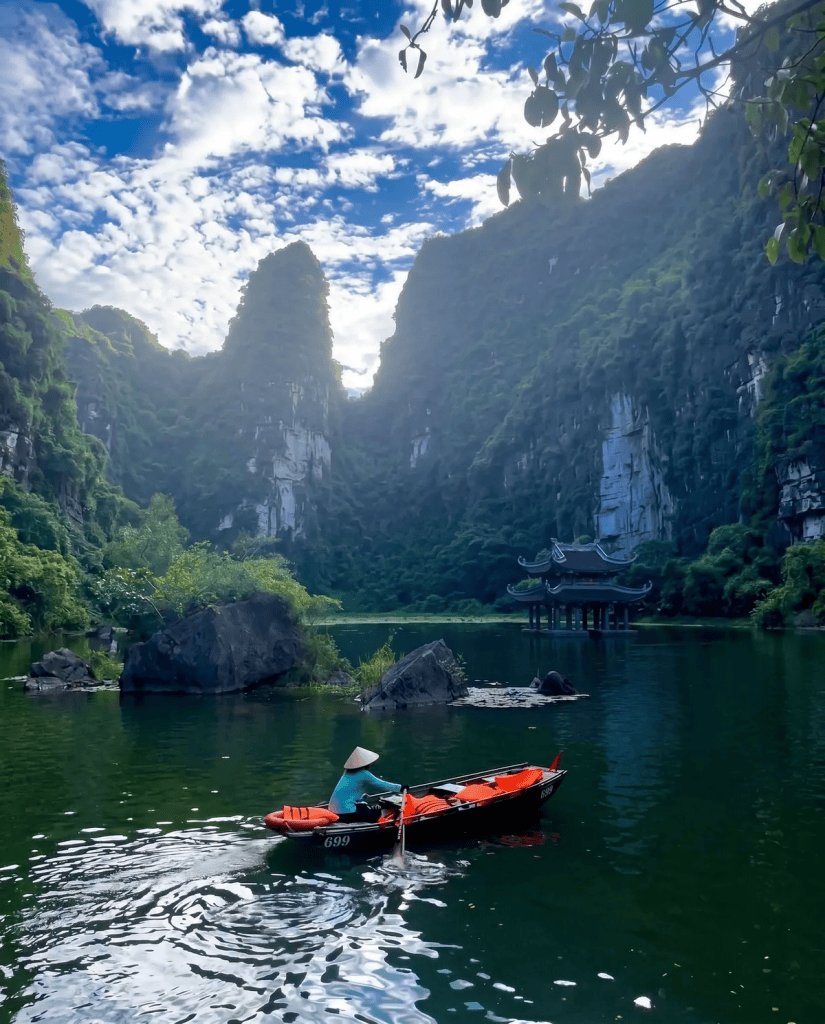
- Trang An’s quieter waterways: longer, less-trafficked routes wind past caves and temples day-trip crowds rarely reach.
- Local rowers as the real guides: many boatwomen and boatmen have rowed these channels for decades, and given the chance, they’ll talk – unhurried conversation, the same spirit behind the people we work with across Vietnam.
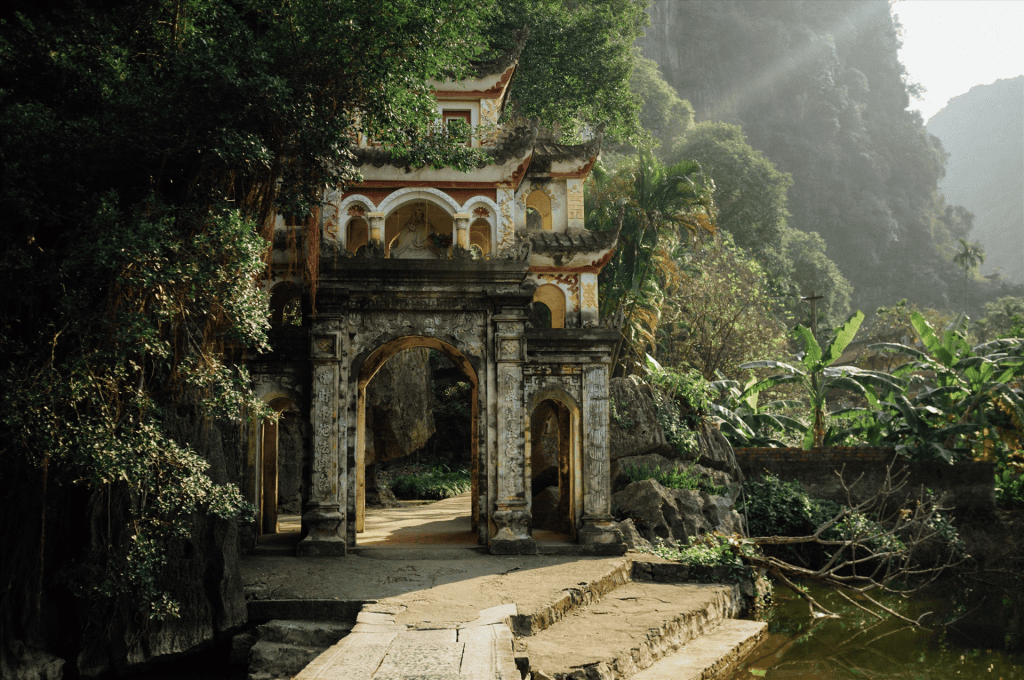
- Bich Dong, the quieter counterpart to Tam Coc: three cave-pagodas built into a cliff face above a smaller river, Bich Dong offers the same drama with far fewer visitors.
2.2 Beyond the Boat: Land Perspectives
The water gets all the postcards, but Ninh Binh rewards getting out of the boat too. Climb above the paddies at dawn or cycle the back lanes, and the landscape suddenly feels three-dimensional.
- Hang Mua’s viewpoint: a steep but manageable climb rewards you with a panorama over the karsts and paddies below – best done early morning.
- Cycling the paddy-field back roads: quiet lanes between Tam Coc and Trang An suit e-bike or guided cycling at a human pace.

- Pairing land and water in one day: the strongest days combine a dawn cruise, a late-morning climb, and resort stillness in the afternoon, an itinerary shaped around the rhythm.
A private sampan at dawn is the single image that sells Ninh Binh – everything else should protect that moment.
3. Where to Stay: Boutique and Countryside Retreats
3.1 Riverside and Lagoon Properties
Where you sleep here matters more than usual – the best properties are a front-row seat to the karst, not just a bed for the night. A handful of names anchor the region.
- Emeralda Resort Ninh Binh: French-colonial-inspired, near Van Long, built around silk-weaving heritage among lotus ponds.
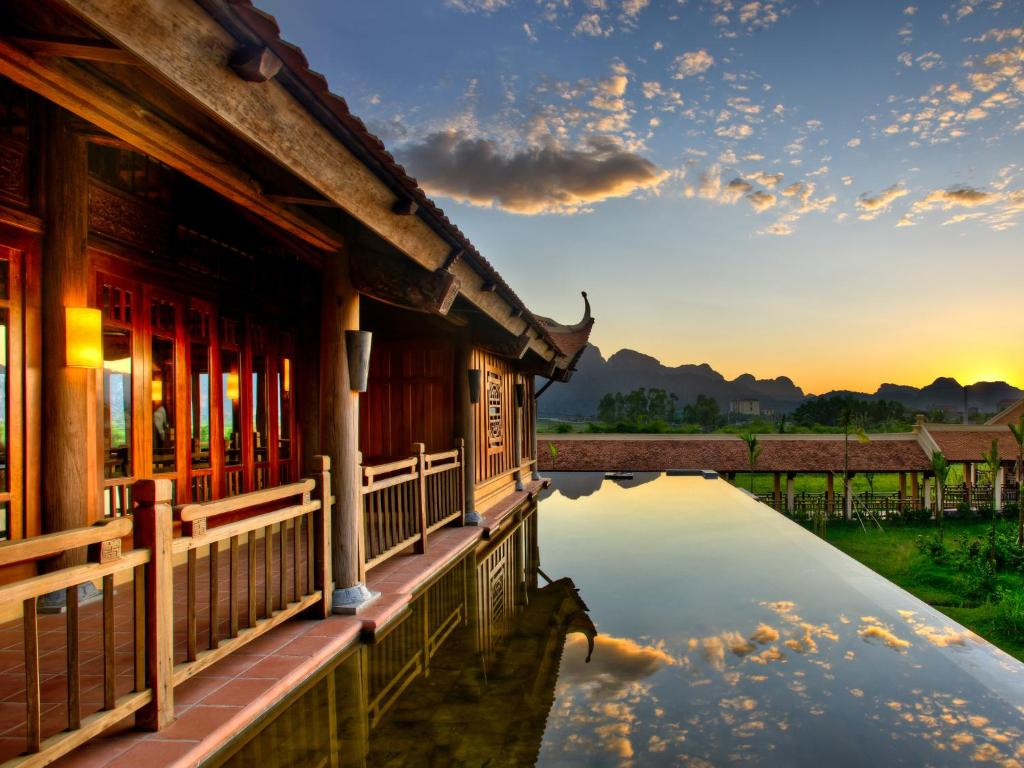
- Wyndham Grand Vedana Ninh Binh: along the Hoang Long River near Cuc Phuong, pairing an international spa brand with karst-and-jungle scenery, per Wyndham’s listing.
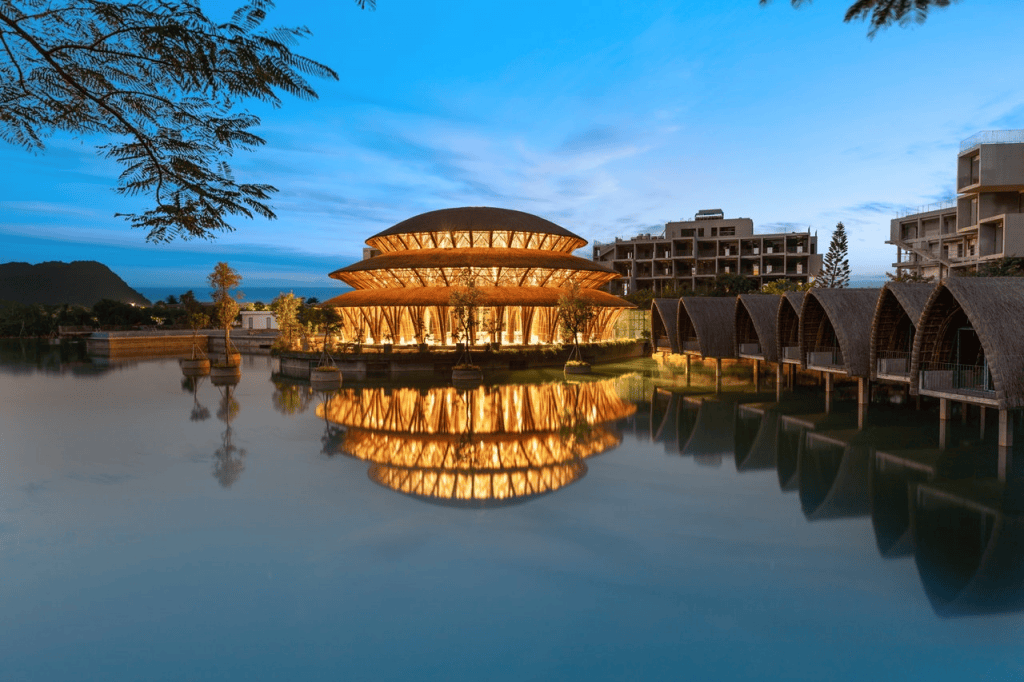
- Smaller boutique retreats near Tam Coc: a growing cluster of design-forward guesthouses and pool villas sit among the paddy fields, ideal for couples wanting intimacy over scale.
- Matching property to itinerary shape: Ninh Binh usually serves as a one- or two-night chapter, so choice often comes down to proximity to Trang An’s boat docks – worth a conversation with a dedicated travel designer.
3.2 What “Boutique” Means Here
“Boutique” gets thrown around loosely in travel marketing. Here it has a specific meaning: a property that lets the landscape stay the main character.
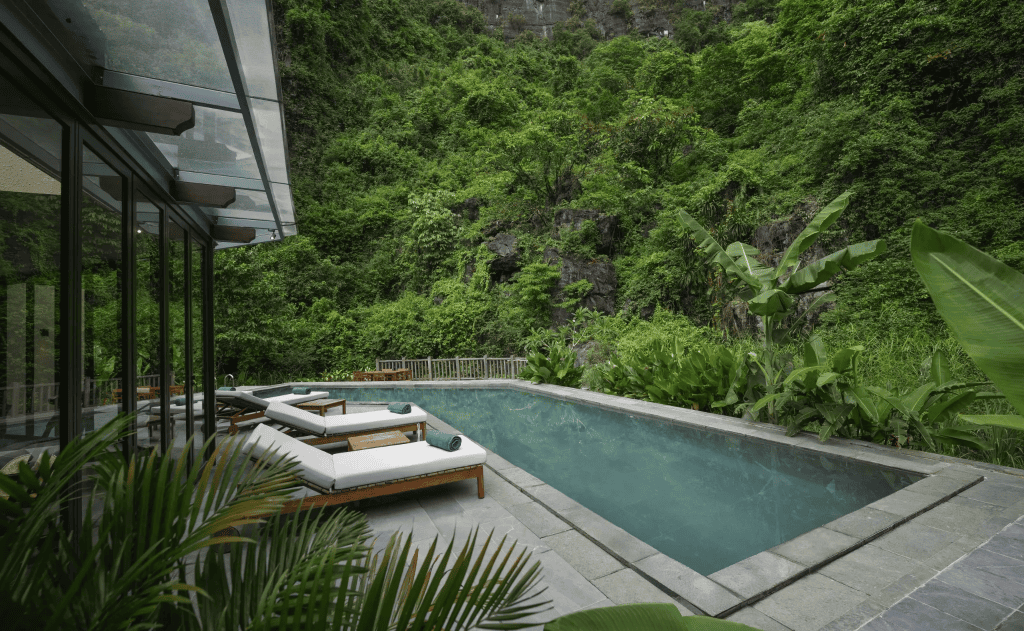
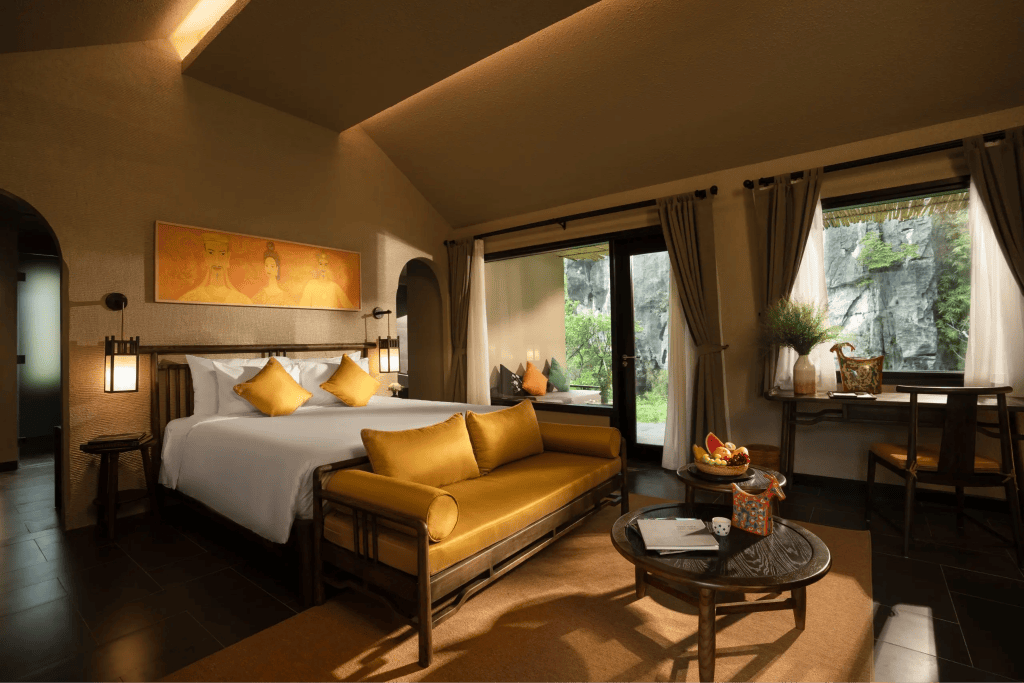
- Architecture in dialogue with the karst: low-rise silhouettes, water features mirroring the rice paddies, rooms oriented toward the limestone.
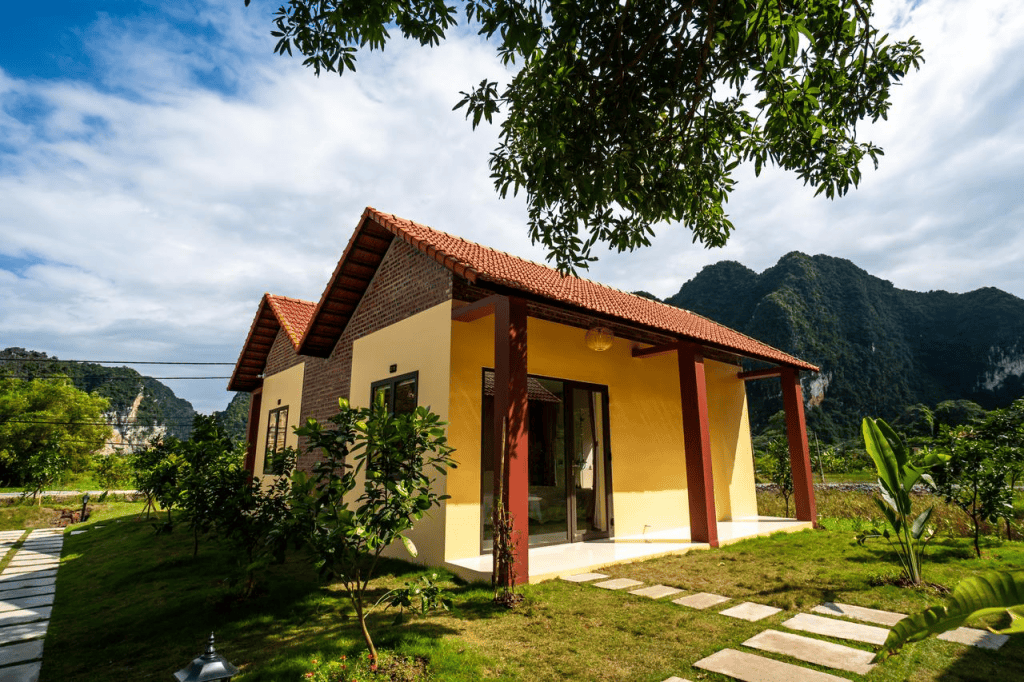
- Wellness as a genuine draw: several riverside resorts run spa programs tuned to the region’s humidity and stillness, a counterpoint to the energy of Hanoi or Ha Long.
- Small footprints, big access: properties near the Trang An buffer zone often arrange private boat and cave access directly from the dock.
- Someone planning behind the scenes: the difference between an average stay and a memorable one usually comes down to a full travel summary – not a stack of loose vouchers.
Here, “boutique” means scale calibrated to the karst – never a resort competing with the view.
4. Beyond the Water: Culture, Wellness, and Table
4.1 A Living Layer of History
Set the boat aside for a day. Ninh Binh reveals a second personality – temples, dynasties, one genuinely good conservation story.
- Hoa Lu, Vietnam’s first ancient capital: seat of the Dinh and early Le dynasties from 968 CE, Hoa Lu predates Hanoi as a capital by decades – compact, uncrowded, best with a private guide.
- Bai Dinh Pagoda’s scale: one of the largest Buddhist temple complexes in Southeast Asia, Bai Dinh holds multiple regional records for its bronze Buddha and bell tower – visit early, before the crowds.

- Van Long Nature Reserve’s conservation story: home to the critically endangered Delacour’s langur, a genuine success documented by PANORAMA Solutions – real wildlife narrative, drifting past on a quiet, unmotorized boat.
- Culture as counterpoint, not filler: Hoa Lu’s history, Bai Dinh’s scale, Van Long’s conservation story – three distinct registers in one day: imperial, spiritual, ecological.
4.2 Dining and Wellness Surrounded by Karst
By evening, the same stillness that defines Ninh Binh’s mornings settles over dinner too. The food here doesn’t try to impress with plating – it impresses because it’s quietly, genuinely regional.
- Farm-to-table countryside dining: riverside resorts and kitchens source directly from surrounding rice-farming and fishing communities, echoed in how the region is approached responsibly.
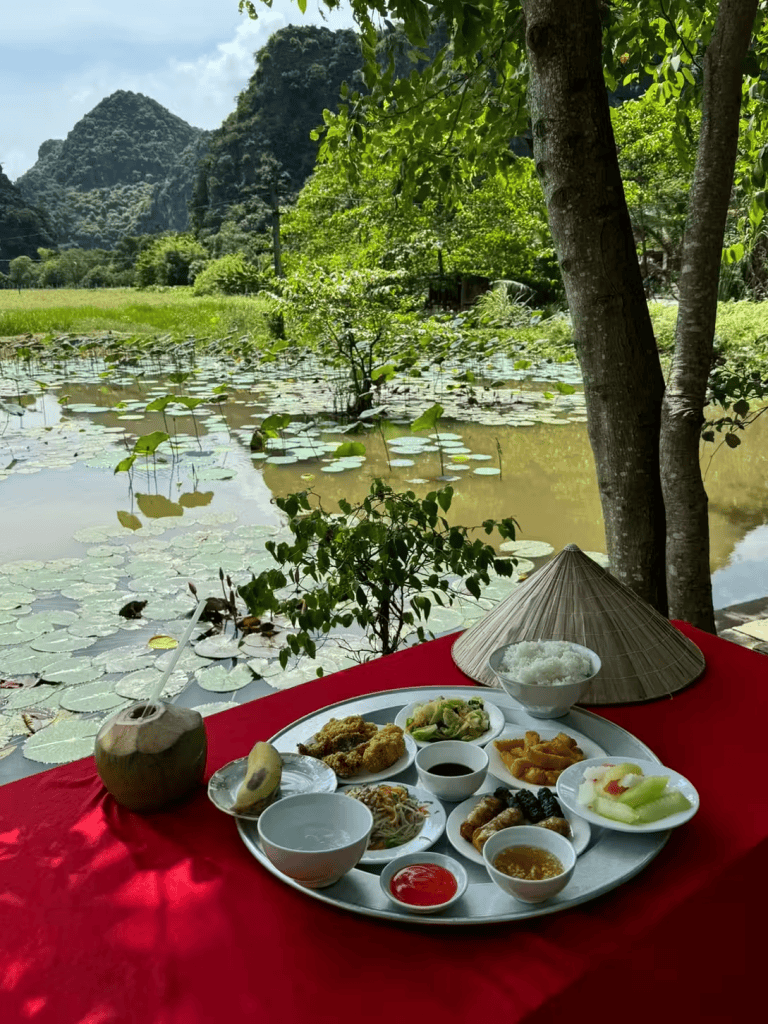
- A genuine culinary signature: freshwater fish, mountain goat, rice-paddy vegetables – an authentic regional table rarely found on standard Vietnam circuits.
- Spa treatments tuned to the landscape: resort wellness programs lean into the region’s herbal traditions, a counterpoint to the intensity of Hanoi or Ho Chi Minh City.
- Private dining on or near the water: several properties arrange sunset meals overlooking the karsts or lotus ponds – reserve in advance.
Quieter than Hoi An’s table, less studied than Hue’s – which is exactly what makes it feel discovered.
5. Designing the High-End Ninh Binh Experience
5.1 Building It Into a Bookable Itinerary
None of this happens by accident. A great Ninh Binh chapter is designed, not stumbled into.
- A proven anchor day: Ninh Binh works well as a full day routed between Hanoi and points further south – a tested rhythm, not a speculative add-on.
- One or two nights, rarely more: long enough for a dawn cruise and a wellness afternoon, short enough to keep momentum toward Ha Long, Hue, or Hoi An.
- Exclusive access as the throughline: private sampans, early-access temple visits, reserved dining slots – what a well-built tailor-made itinerary is designed to deliver.
- Support that doesn’t stop at check-in: 24/7 in-trip support, plus an optional virtual guide over WhatsApp, means a 9pm question actually gets answered.
5.2 What Makes the Experience, Not Just the Scenery
The karsts photograph themselves – that part takes care of itself. What shapes whether the trip feels extraordinary or merely pretty comes down to a few deliberate choices.
- Exclusivity over spectacle: the landscape needs no embellishment; what elevates it is the private sampan, the boutique retreat, the empty viewpoint at dawn.
- The Ha Long comparison, reframed: if you already know Ha Long Bay’s karst scenery from a thousand photos, Ninh Binh reads instantly as its quieter, land-based cousin.
- A rhythm-changer, not a detour: Ninh Binh works best as recovery time between higher-energy stops – a deliberate pause, not a gap to fill.
- Real support behind the postcard: a trip here is only as good as the planning and 24/7 support standing behind it.

The magic isn’t the scenery alone – it’s the access, pace, and support that make it feel earned.
6. The Mango Tiger Way in Vietnam
6.1 People with Purpose
A place is only as good as the people who show it to you. In Pu Luong, a brocade weaver has practiced her craft since age six – nearly seventy years of mastery shared inside her own home. In the Cham Islands, Tinh, a young coordinator, was trained in operations, safety, and guiding from the ground up. In the Mekong Delta, Mrs. Danh has run a family homestay for fifteen years, hosting up to seventy guests and leading her own cooking classes. These are the people – not brochures – who define what a trip through Vietnam feels like. Meet the team behind these connections.
6.2 Places with Purpose
From the UNESCO-listed karsts of Trang An to the rice terraces of Pu Luong and the waterways of the Mekong Delta, the strongest itineraries are built around places that reward a slower look – Ninh Binh included. Under Vietnam Country Manager Doung, the program links Hanoi, Ha Long or Lan Ha Bay, Ninh Binh, Hue, Hoi An, and the southern beaches into one coherent arc, not a checklist of stops. Explore the destination framework at mangotiger.com/destinations/vietnam.
6.3 Products with Purpose
Every itinerary is judged on how it’s built: personalized routing around a traveler’s interests and budget; exclusive access to private tours and dining; flexible planning through a dedicated travel designer; support that continues past departure, including 24/7 in-trip assistance and an optional WhatsApp virtual guide. Underpinning it all are real sustainability commitments – a plastic-reduction partnership with TonToTon, carbon-neutral tour options via Gold Standard Certified Projects, and a standing preference for local, family-run suppliers. More at mangotiger.com/impact and responsible travel.
About Mango Tiger
Mango Tiger is an Asia-based Destination Management Company built on three values: Fresh, Authentic, and Passionate. Led by CEO Jack Bartholomew and Managing Director Niel Fraser, the company designs journeys across Vietnam, Cambodia, Laos, Thailand, Indonesia (Bali), and the Philippines for travelers who want more than a template.
Every itinerary is shaped by a dedicated travel designer around a traveler’s genuine interests and budget – backed by exclusive local access, a full travel summary instead of loose vouchers, and round-the-clock in-trip support. That combination turns a place like Ninh Binh from a photo stop into the refined, unhurried escape it’s capable of being. Full story at mangotiger.com/about.
Ninh Binh doesn’t need embellishment – it needs the right access, pace, and someone who already has both figured out. Ready to trade a crowded tour boat for a private sampan at dawn? Get in touch or book now to build Ninh Binh into your next Vietnam trip.
